Utilization is the new AI mandate.
Download Hyperstellar's practical guide to turning idle, fragmented GPU and compute resources into verified, governed, business-ready AI capacity.
A practical framework for AI compute capacity.
Built as a working guide rather than a single read: six imperatives, a maturity model, and the questions that separate durable platforms from point solutions.
Why record AI infrastructure spending can still leave organizations capacity-constrained.
The binding constraint is no longer only how much capacity exists. It's whether that capacity can be found, verified, governed, and put to work.
How stranded capacity, fragmentation, governance gaps, and auditability issues limit AI progress.
Five structural challenges survive every purchase order: visibility, utilization, fragmentation, governance, and auditability. Adding hardware repeats the same economics at larger scale.
The six imperatives of capacity orchestration: utilization, verification, workload placement, governance, scalability, and auditability.
Each imperative is paired with the problem it addresses and the solution the playbook recommends, from pooling across sites to verifiable records across the full lifecycle.
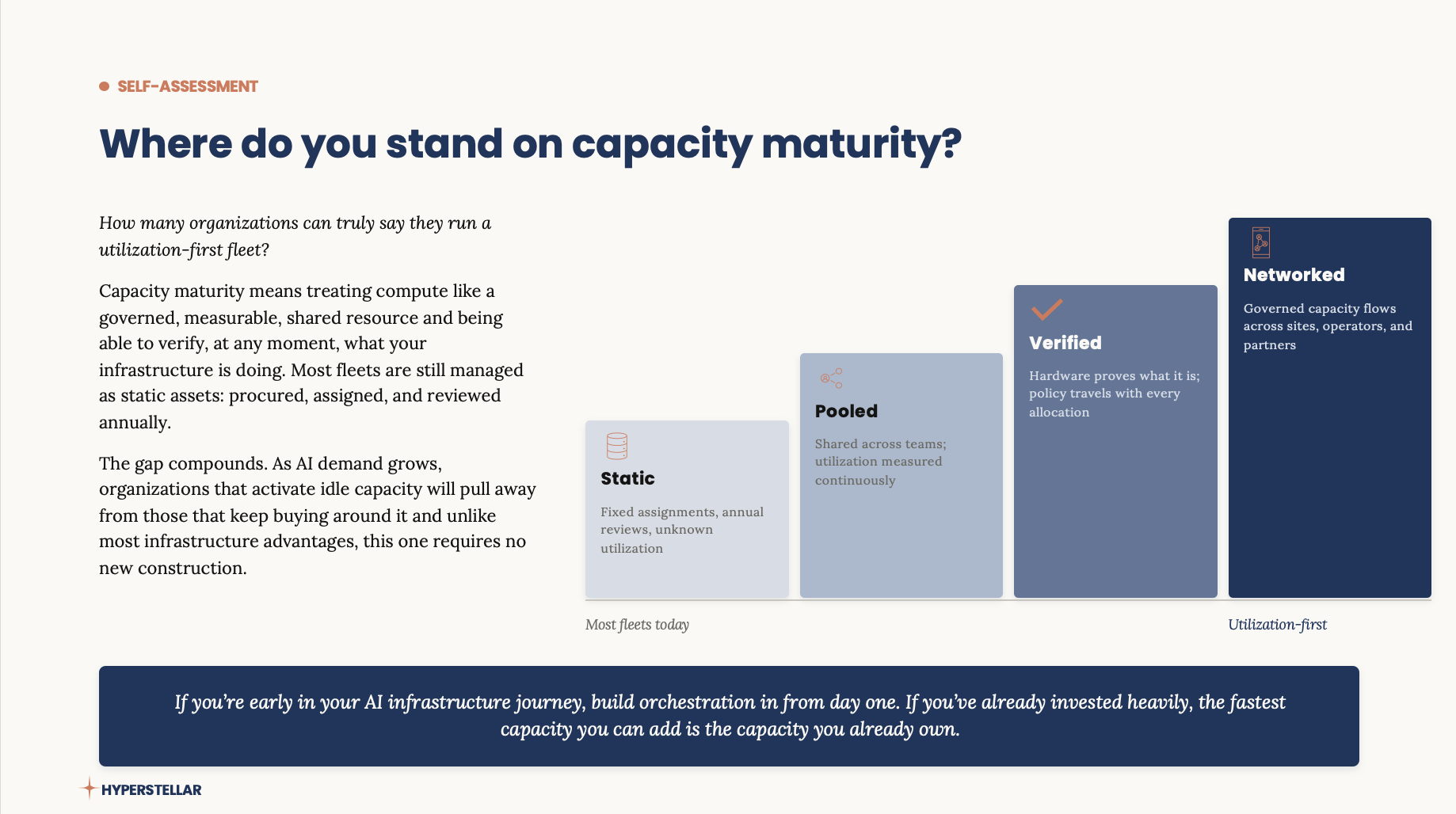
How to assess capacity maturity, from static allocation to networked compute.
Four stages: static, pooled, verified, networked. Most fleets today are still managed as static assets, procured, assigned, and reviewed annually.
What to ask when evaluating orchestration platforms and HV-OS-style architectures.
A buyer's checklist of thirteen questions, from verification and neutrality to interoperability, economics, and future-readiness, followed by how HV-OS is designed to answer them.
Written for AI infrastructure and finance leaders.
Compute, Networked is a working guide to monetizing the compute you already have, or accessing it from peers. It sets out a utilization-first operating model: capacity treated as a measured, governed, shared resource, rather than a static asset that is procured, assigned, and reviewed annually.
It gives you a maturity model to locate your own fleet, from static allocation to networked compute, and a buyer's checklist of thirteen questions for evaluating any orchestration platform, including HV-OS, the Hyperstellar hypervisor operating system for pooled capacity.
Illustrative figures in the playbook are management estimates, not measured results, and its scenarios describe intended product use rather than existing customers.
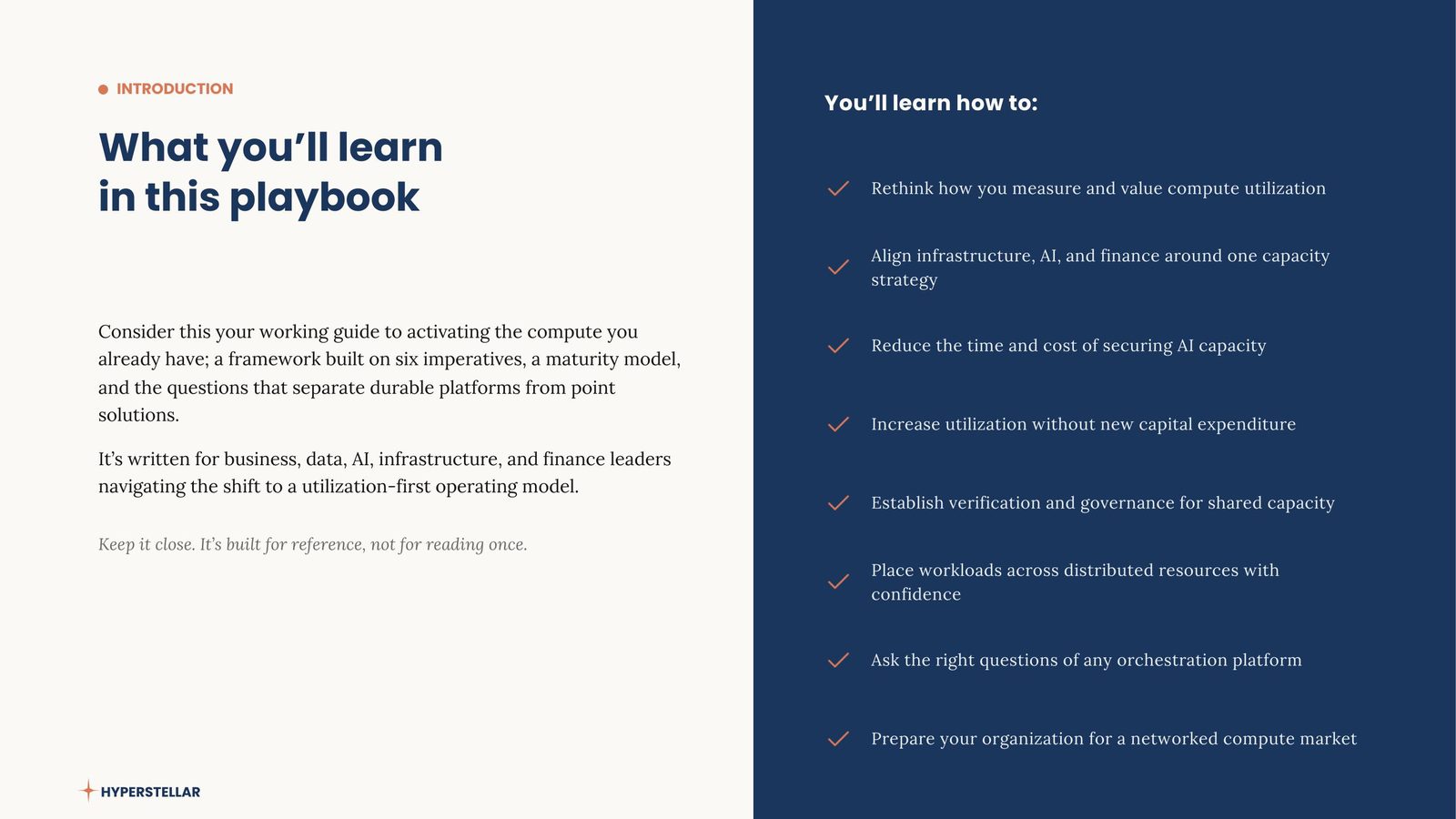
- Rethink how you measure and value compute utilization
- Align infrastructure, AI, and finance around one capacity strategy
- Reduce the time and cost of securing AI capacity
- Increase utilization without new capital expenditure
- Establish verification and governance for shared capacity
- Place workloads across distributed resources with confidence
- Ask the right questions of any orchestration platform
- Prepare your organization for a networked compute market
Start with the capacity you already have.
Read the playbook, then talk with Hyperstellar about how verified, governed capacity can become part of your AI infrastructure strategy.
Who is this playbook written for?
Business, IT, AI, data, infrastructure, data center, GPU cloud, network and edge, and finance leaders: anyone who suspects their most affordable AI capacity is the capacity they have already built, and who needs infrastructure, AI, and finance to work from one picture of it.
Is the playbook free?
Yes. There is no paywall. We ask for a work email so we can deliver it and, occasionally, send Hyperstellar updates. You can unsubscribe at any time.
What is HV-OS?
HV-OS is the Hyperstellar hypervisor operating system for pooled capacity. It runs beneath workloads, pools underutilized resources, and makes them available on a verified, auditable basis. Existing workloads, including VMs, Linux environments, and Kubernetes clusters, run unchanged above it. HV-OS is in active product development; the playbook describes its current design.
Does Hyperstellar own the compute capacity?
No. Operators keep ownership and control of their hardware and set the policy for what is offered, to whom, and on what terms. Hyperstellar provides the software layer in between, offered as a subscription with usage-based platform fees, and does not compete with the people who own capacity. Hyperstellar is not a cryptocurrency business and does not hold or transmit customer funds.
Is this for operators, buyers, or enterprises?
All three. The playbook is written for data center operators, GPU cloud providers, enterprises with AI fleets, network and edge providers, and AI teams that need capacity they can trust. Its illustrative scenarios follow a regional operator, an enterprise AI team, and a distributed fleet owner.
Can I share the playbook with colleagues?
Please do. It's built for reference, and it works best when infrastructure, AI, and finance teams read the same copy. Forward the PDF or send colleagues to this page.